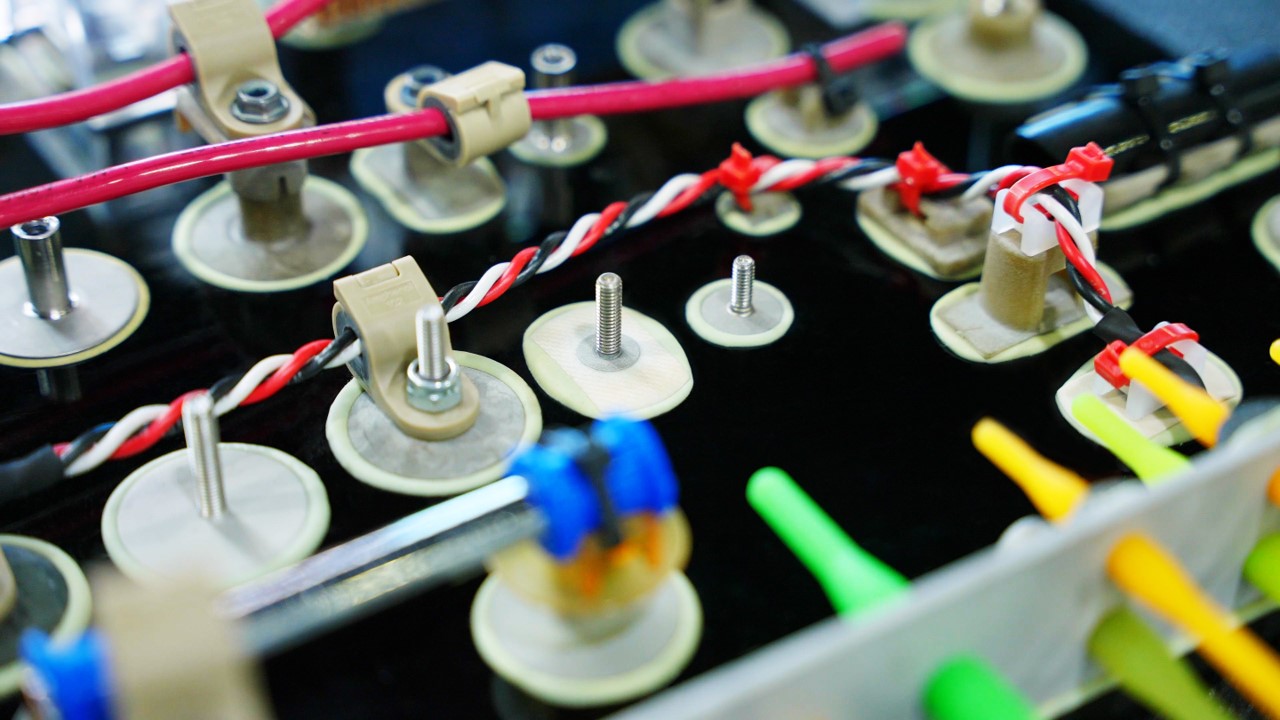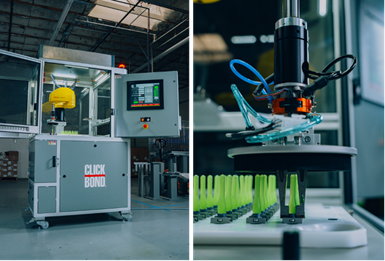





A small fuel leak dripping from an airplane wing more than 40 years ago led to a manufacturing process that today bonds aircraft together, from the F-16 to the F-35. Bill Perez, senior global product manager at Click Bond, gave a drill-down into the power of bonding in aerospace manufacturing on the HUB stage during the 2025 AIAA SciTech Forum in Orlando, Florida.
A small leak, a big idea
Forty years ago, a young physicist, entrepreneur, and Air Force veteran walked out to his airplane and noticed a small drip from the underside of a wing. It was not condensation. It was fuel, seeping from a rivet on the bottom of the wing. Traditionally, that repair meant draining the wing, clearing the fumes, and drilling the rivet out, a job that could ground the aircraft for a week or more.
That entrepreneur was Charlie Hutter. As a seasoned design engineer, he knew of an adhesive that could cure in the presence of fuel, and he knew the wing was not a pressurized vessel. So he asked a simple question: why not just seal the leak permanently, without draining the wing or replacing the rivet? Using an innovative pressure-application fixture, he bonded a small aluminum foil patch over the leak. Activated with a signature "click," it clamped down and formed a strong, reliable bond. The Click Patch® was born, and it went on to preserve those same style wings on the F-16.
Click Bond was born out of the idea that holes do not belong on an aircraft.
See it for yourself
Why Bond?
Bill Perez walks through the science and the advantages of adhesive-bonded fasteners over mechanical fastening in a short video on our Why Bond page.
Watch Why Bond? →Fast forward to today
Click Bond was once told that airplanes would never be glued together. Today the most advanced fighter in the world, the F-35, is largely held together with bonded fasteners. It was built by engineers who were pioneering with purpose, embracing bonding to meet the demands of the platform.
The reason is weight. The penalty of mechanical fasteners is not just the fasteners themselves, but every extra hole that must be drilled to accommodate them. High-performance materials lose their advantage when they have to be thickened to carry all those perforations. Bond the fasteners instead, and the structure can be designed intact, with all the benefits the material was chosen for in the first place.
Bill Perez on the power of bonding, from the science of adhesion to the benefits over mechanical fastening.
The science of bonding
Adhesive bonding is not glue in the everyday sense. It is the sum of several mechanical, physical, and chemical forces working together. Perez walked the SciTech audience through the four that matter most: mechanical interlocking, where adhesive flows into the abraded texture of the surface and locks in like an anchor; electrostatic forces, where opposite charges attract as the adhesive cures; adhesion, the intimate molecular contact between adhesive and substrate; and diffusion, the entanglement of adhesive within the surface. It is the combination of all four that creates an excellent bond.
The common thread is the surface. A freshly abraded surface carries high surface energy and bonds beautifully, but it begins to oxidize within seconds and continues over minutes and hours, lowering that energy. Understanding and controlling surface preparation is what makes bonding repeatable and reliable.
Eight benefits of bonding
Perez laid out eight reasons designers and engineers should reach for bonding over mechanical fastening. It improves cycle time, a bonded nutplate installs in about 30 seconds versus three minutes or more for a riveted one. It reduces foreign object debris by eliminating loose rivets, washers, and bolts. It reduces production costs by removing specialized tooling, training, and drilling steps. It simplifies repairs and maintenance with a three-step process that works in the factory, at sea, or in the field.
It prevents corrosion, placing an adhesive barrier between fastener and structure to isolate galvanic pathways. It reduces weight through hole elimination and localized reinforcement. It avoids errors and rework, since a major share of shop-floor rework traces back to misdrilled holes. And it preserves structural integrity, removing stress concentrations and the fatigue cracks that drilled holes can start. Where a standard riveted nutplate needs three drilling events, Click Bond's rivetless nutplate needs one.
The skeptic's question is always strength. Click Bond tested bonded fasteners against mechanically fastened ones and found equivalent strengths, with every bonded configuration clearing the minimum requirement. The failure modes differ in Click Bond's favor: a bonded nutplate can be removed with a simple heat source and re-bonded after the surface is re-prepared, while a failed mechanical fastener requires full removal and reinstallation, with real risk to the underlying structure.
Go deeper
The Benefits of Bonding
Improved cycle time, reduced FOD, decreased weight, better structural integrity, and lower cost. See how adhesive-bonded fasteners deliver all these benefits and more.
Benefits of Bonding →