




Adhesive bonding has long been hailed as an ideal way to fasten composite structures. It avoids the fiber damage, delamination risk, and added weight that come with drilling and bolting, leaving assemblies that are stronger and lighter. In a February 2026 feature, CompositesWorld editor-in-chief Scott Francis examined the question that comes next: How do you scale that process for the high assembly rates that next-generation aerospace companies will demand?
A legacy built on removing variability
Click Bond began in 1987 with a simple idea. Pilot and inventor Charlie Hutter needed to fix a leaking rivet on his aircraft, and a foil patch grew into a global business supplying bonded fasteners and installation systems across aerospace, defense, marine, and mobility. The company has since designed more than 4,000 adhesive-bonded fasteners, from studs and standoffs to brackets and cable-tie mounts, all engineered to be bonded rather than riveted.
The thread running through all of it has always been the same: remove variability from the process. For every fastener, a disposable fixture controls the exact pressure and the precise amount of adhesive applied. As Bill Perez, Senior Product Application and Strategy Manager at Click Bond, puts it in the article, the goal is to match the performance of a riveted nutplate while eliminating all the unnecessary holes.
Done properly, a bonded fastener can match or exceed the strength of a drilled one, without ever putting a hole in the structure.
New to bonding?
Start with the Science of Bonding
Before going further, it helps to understand why bonding outperforms manual fastening that relies on drilled holes, rivets, and bolts in the first place. Bill Perez walks through the principles in a short presentation on our "Why Bond?" page.
Why Bond? →The challenge is scale
For all its advantages, bonded fastening has traditionally been a manual, time-intensive process. A technician cleans, abrades, and activates the composite surface, dispenses mixed adhesive, positions the fastener with a fixture, and holds it under pressure until cure. Each step demands precision in surface cleanliness, application accuracy, and cure pressure, and each step adds time, labor, and cost.
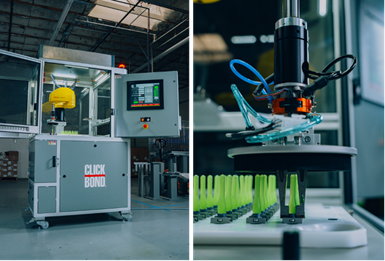
That tension sits at the heart of the CompositesWorld story. As commercial single-aisle programs and eVTOL aircraft push toward far higher production rates, the industry needs fastening methods that preserve structural integrity without slowing the line. To meet that demand, Click Bond is investing in automation and digital tools that standardize every stage of the bonding process.
Automation and extended reality
The objective, Perez explains in the article, is that every single bond is identical, whether it is installed on day one or day 1,000, by technician A or technician Z. Automation is what makes that level of repeatability possible at scale.
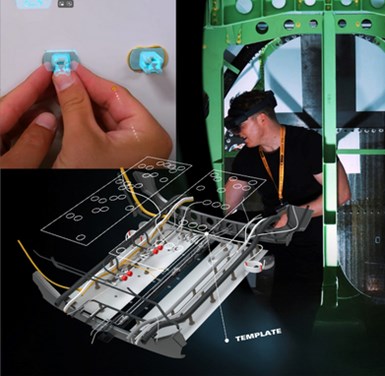
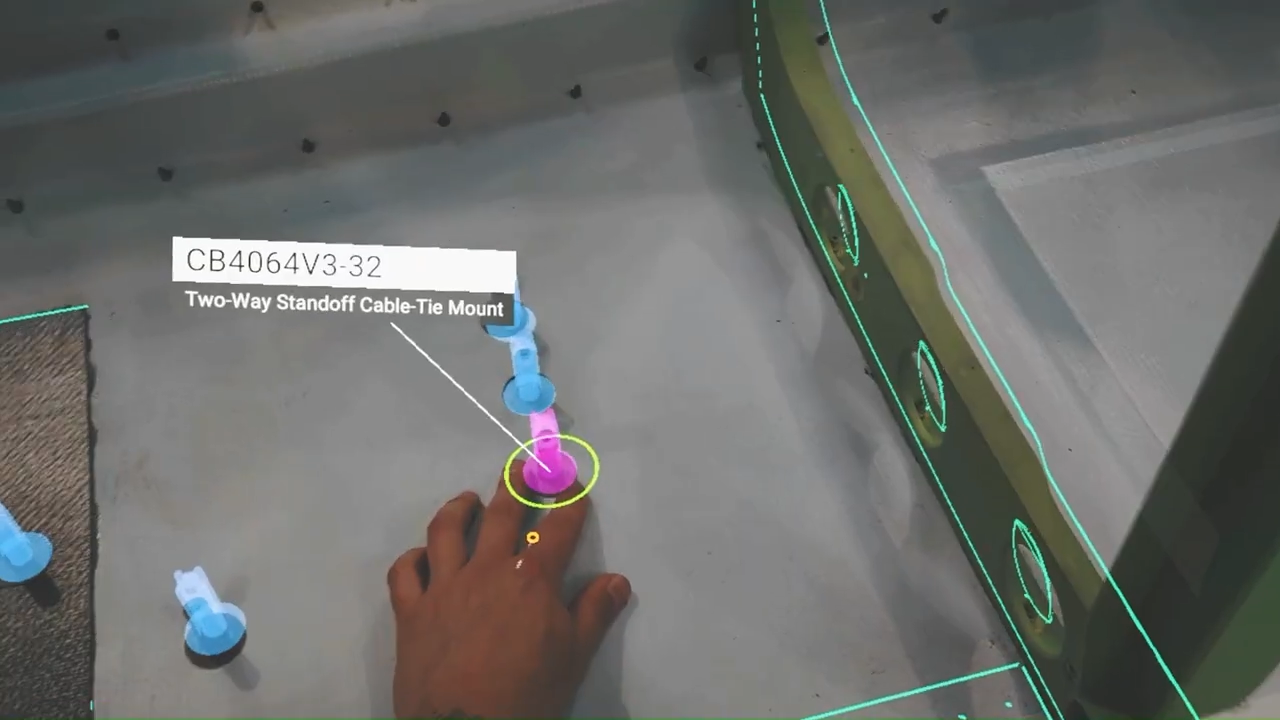
One persistent challenge is locating fasteners accurately on large composite panels, work that once relied on complex jigs and physical templates. Click Bond's Digital Solutions program replaces those with extended reality. Technicians wearing XR headsets see augmented overlays projected directly onto the structure, showing exactly where each fastener belongs. The result is faster installation with no layout steps, real-time placement verification within tolerances as tight as one millimeter, and automatic digital traceability that logs who placed each fastener and when.
Click Bond Digital Solutions use an AR-powered headset to project 3D placement templates directly onto the airframe.
Proof on the production floor
The article points to a concrete result. In a pilot program with Vertical Aerospace in Bristol, UK, XR-guided installation took an assembly task scheduled for three weeks and completed it in five days. By eliminating manual measurements and the creation and placement of alignment templates, the approach cut setup, installation, and validation time across thousands of components.
Beyond speed, the method addresses some of the industry's harder problems: adapting quickly to design changes, reducing rework, easing workforce skill shortages, and turning complex procedures into clear, repeatable visual steps that a digital-first generation can learn fast.
Go deeper
The Benefits of Bonding
Improved cycle time, reduced FOD, decreased weight, better structural integrity, and lower cost. See how adhesive-bonded fasteners deliver all these benefits and more.
Benefits of Bonding →