






Can bonded fasteners replace rivets?
Can bonded fasteners replace rivets or mechanical fasteners? Bonded fasteners deliver strong, hole-free attachments that protect substrates, cut weight, and boost performance.
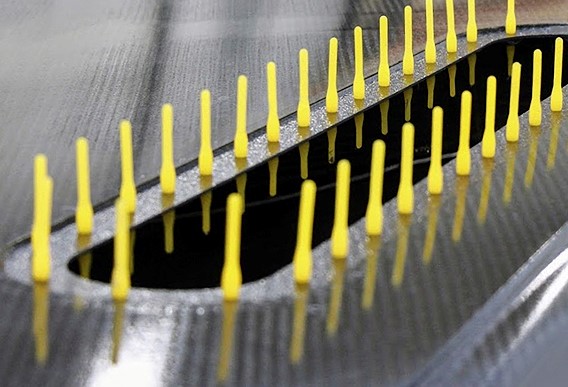
Short Answer:
Yes. Bonded fasteners can replace traditional rivets or other mechanical fastening methods in many structural and semi-structural applications, offering strong, durable, hole-free attachments without damaging composite or metallic substrates.
Full Answer:
Adhesive-bonded fasteners have proven to be reliable and efficient alternatives to drilled or riveted joints in both metallic and composite assemblies. Unlike mechanical fasteners that require the drilling of holes, countersinking, and localized stress concentrations, bonded fasteners attach directly to the surface with adhesive, creating a hole-free joint that preserves the structural integrity and performance of the base material.
By eliminating drilling, installers avoid fiber damage, delamination, and weight penalties associated with added fasteners, installation hardware, and thickened substrate. The result is a cleaner, lighter, and more aerodynamic assembly that meets the demanding requirements of modern aerospace, defense, and advanced manufacturing programs.
Bonded fastening technology doesn’t simply match the performance of mechanical fasteners — it exceeds their performance by improving repeatability, reducing corrosion pathways, and enabling new design freedom for engineers working with thin skins, honeycomb panels, or advanced composite structures.
Key advantages of bonded fasteners over traditional mechanical fastening:
- Hole-free installation – Protects fiber continuity in composites and prevents stress concentrations around drilled holes.
- Improved fatigue and load distribution – Adhesive bonds distribute loads uniformly across the joint surface instead of concentrating stress at a single fastener point.
- Reduced weight and part count – Eliminating rivets, nuts, and rear-access hardware saves time and reduces assembly weight. Additionally, having fewer holes in your substrate allows the material to remain as thin as possible – saving weight on your aircraft or other program.
- Enhanced corrosion resistance – Adhesive sealing isolates dissimilar metals and eliminates leakage paths for moisture or contaminants.
- Cleaner aerodynamics – Flush, low-profile bonded attachments maintain smooth surfaces, which are ideal for high-performance applications.
- Simplified installation – Surface-mounted bonding reduces labor time and eliminates the need for drilling, countersinking, or taking secondary sealing steps.
- Reduced FOD potential – Without the need to drill holes and install fastening hardware, less substrate material is removed from the structure. This means that there’s less risk of FOD being released into the application area.
Proven Performance & Industry Trust
For more than four decades, Click Bond has partnered with leading aerospace and defense manufacturers to replace traditional riveted fasteners with adhesive-bonded fasteners that meet stringent performance, qualification, and traceability requirements. Our fasteners are flight-qualified and field-proven across dozens of high-performance platforms, from commercial airliners and rotorcraft to naval vessels and spacecraft.
Each bonded fastener we make undergoes rigorous mechanical, fatigue, and environmental testing to validate structural performance under vibration, load, and temperature extremes. Click Bond’s adhesives, installation systems, and process controls are certified to meet the exacting standards demanded by OEM and MRO environments worldwide.
As manufacturing demand leads to higher rates of production, Click Bond’s Automated Bonding Technology (ABT) system meets that demand by enabling customers to install adhesive fasteners at the necessary production speed, all while maintaining quality, consistency, and traceability data for every bond.
The result is a fastening solution trusted by engineers, validated by decades of service, and ready for the next generation of high-performance assembly.
In summary:
Bonded fasteners can effectively replace rivets or other mechanical fasteners in many applications, delivering lighter, stronger, and more reliable assemblies — especially important for composites and advanced materials. Backed by decades of qualification, testing, and automation innovation, Click Bond empowers manufacturers to move confidently from traditional drilling to scalable, high-integrity bonded fastening.